
Yes, you can move here on a VA or FHA loan and buy a house with a well, a septic system and a shop out back. The loan still has to clear an appraisal, and the rules for rural property are more specific than most city buyers expect. VA dropped its separate radon requirement and streamlined its rules on detached buildings for appraisals ordered after May 1, 2026. Washington requires a septic inspection at least every three years on a basic gravity system. And on the rural edges of Kitsap and Mason counties, the typical home value in September 2026 ran from $418,789 in Shelton to $714,644 in Olalla.
A lot of the people I help relocate grew up on city water and city sewer. Then they see a listing in Seabeck or Belfair with an acre, a barn and a view of Hood Canal, and the questions start. Can my loan do this? What do I test? How far is the drive to the base? This post is about the move side of that decision: where the land is, what living on a well and septic actually involves, and what to line up from out of state. I recorded the video with Roger Merrell Jr., a licensed Washington home inspector, HUD compliance inspector and HUD-approved 203(k) consultant, and his experience runs through it. If you want the loan programs in detail, I wrote that up on my Journal.
Where the Land Is in Kitsap, Pierce and Mason
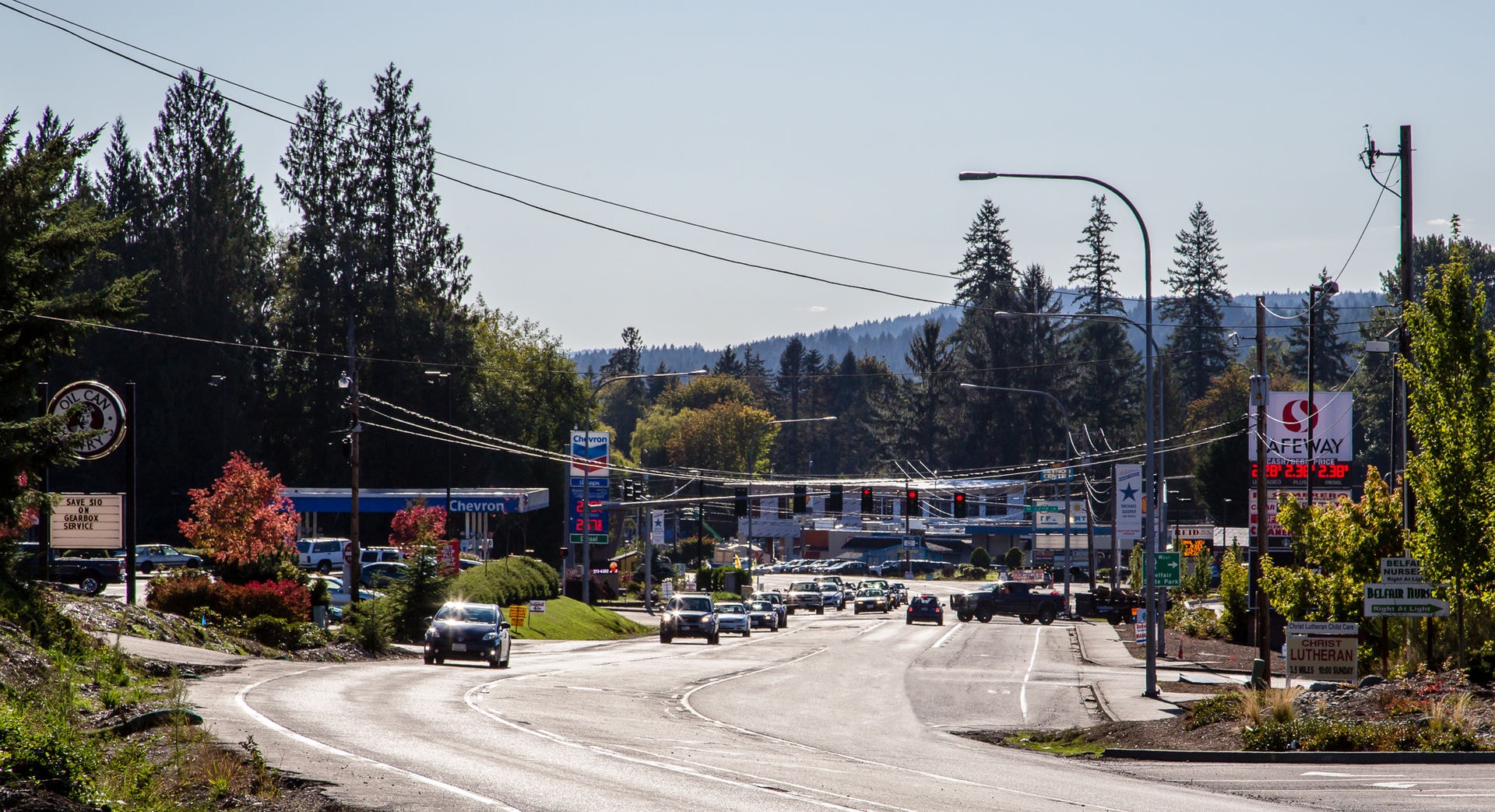
In my experience, most of the acreage within reach of the bases is on the west and south sides of the region: the Hood Canal shore from Seabeck down through Belfair and Union, the Shelton area at the south end of Mason County, and the stretch between Port Orchard and Gig Harbor around Olalla. Roger also named Southeast Pierce County, where he said a dozen outbuildings on one property is not unusual.
Here is what the typical home costs in each of those towns, beside the typical drive to the three places most of my military and shipyard clients report to. The values are Zillow's Home Value Index for September 2026, described by Zillow as the typical home value for mid-tier single-family homes and condos, smoothed and seasonally adjusted. It is a model estimate, not a sale price, and it blends in-town lots with acreage. The drive times are the typical one-way ranges from my commute calculator.
| Town | County | Typical home value, Sept. 2026 | To the shipyard (PSNS) | To Bangor | To JBLM |
|---|---|---|---|---|---|
| Shelton | Mason | $418,789 | 45 to 60 min | 50 to 65 min | 50 to 70 min |
| Belfair | Mason | $478,269 | 25 to 35 min | 30 to 40 min | 55 to 75 min |
| Union | Mason | $512,292 | 40 to 55 min | 45 to 60 min | 55 to 75 min |
| Seabeck | Kitsap | $687,186 | 30 to 40 min | 25 to 35 min | 80 to 100 min |
| Olalla | Kitsap | $714,644 | 25 to 35 min | 40 to 50 min | 40 to 55 min |
Source: Zillow Home Value Index (typical home value: mid-tier single-family and condo, smoothed and seasonally adjusted), September 2026. A model estimate, not a sale price.
See the numbers
| Item | Value |
|---|---|
| Olalla | $714,644 |
| Seabeck | $687,186 |
| Union | $512,292 |
| Belfair | $478,269 |
| Shelton | $418,789 |
Reading the map before the listing
Seabeck is the clearest example of the trade. It is 25 to 35 minutes to Bangor on a normal day, which is close for a home on Hood Canal, but it is 80 to 100 minutes to JBLM. If your next orders could point south, Olalla keeps both the shipyard and JBLM under an hour. Shelton costs the least of the five, but it is the longest drive to the shipyard.
Belfair, Union and Olalla all reach the shipyard on Highway 3 or Highway 16 through Gorst, where the morning backup is the part of the commute you feel. Drive it at your real report time before you commit, or have me do it on video.
What the Appraisal Looks At on Rural Property
The appraisal is where city habits meet rural property. VA and FHA both require the home to meet their minimum property standards, and the things that make rural homes appealing (a shop, a barn, a well, a drainfield) are also the things an appraiser has to look at.
VA's 2026 changes
On June 25, 2026, VA announced revisions to Chapter 12 of its Lender's Handbook, the chapter that sets minimum property requirements. VA's announcement lists these changes:
| Topic in VA's handbook | What VA did |
|---|---|
| Radon gas (Topic 34) | Removed the full requirement |
| Detached improvements (Topic 1) | Streamlined the guidance |
| Non-vented heaters (Topic 23) | Updated the guidance |
| Homes built before 1978 (Topic 32) | Revised the standards |
| Homes built in 1978 or later (Topic 32) | Revised the standards |
VA's revised chapter applies to appraisals ordered after May 1, 2026, the date I gave in the video. VA said that as of May 31, 2026, the average VA appraisal took about seven business days.
Roger's view is that this was overdue. Before the change, he said, every shed, shop, loafing shed and barn on a property had to meet the standards. He was also clear that it is not black and white: an outbuilding that is a genuine hazard can still come up. My advice is simple. If a building on the property is unsafe, plan to repair it or take it down, whatever the loan.
FHA has not followed yet
Roger expects FHA to make a similar change, but as of the video it had not. In his experience, an FHA appraisal still looks at outbuildings, and the most common flag he sees in Western Washington is flaking paint, even on a fence. If you are on an FHA loan and the property has several buildings, walk all of them with your inspector before the appraisal is ordered.
Radon is still worth testing
With the radon topic gone, the appraisal no longer addresses radon at all. That says nothing about the house. If you want to know, order a test during your inspection period.
Living on a Well
On a well, you are your own water utility. Nobody sends a bill, and nobody tests it for you after closing.
What gets tested before closing
Roger said that in practice FHA and VA loans get a water test. The usual panel checks for bacteria (total coliform and E. coli) and for nitrates and nitrites. He said nitrates are rarely an issue in most of Western Washington. When a well tests positive for coliform, the common fix is to shock it: chlorine goes down the well, gets run through the system, and the water is retested before closing.
The rest of the due diligence
The well log, the setback from the drainfield and any shared-well agreement are covered in my Guide article on septic and wells on rural Washington homes. Read it before you write the offer. The part that is specific to your loan is the water test above.
Living on a Septic System
Most homes outside the town centers here run on septic. The rules are set by the state and enforced by the county health department, so the paperwork you see depends on whether the home is in Kitsap, Pierce or Mason County.
The inspection schedule is state law
Under WAC 246-272A-0270, the owner of an on-site sewage system must have it inspected by a provider the local health officer authorizes. The schedule is at least once every three years for a system that is only a tank and a gravity drainfield, and every year for every other kind of system, unless the local health officer requires more. Results go to the local health jurisdiction.
| System type | Minimum inspection under WAC 246-272A-0270 |
|---|---|
| Septic tank with a gravity drainfield | At least once every three years |
| Every other system (pressure, mound, sand filter and others) | Every year |
That second row matters. In my experience, a lot of waterfront homes have alternative systems, and Roger called them very temperamental. An annual inspection is part of owning one, so ask which kind of system the home has before you write the offer.
Daily habits
Roger's rule of thumb is to pump about every five years, keep grease and butter out of the drain, and use a detergent that will not upset the system. Each county health department has its own records for the property: Kitsap Public Health District, Tacoma-Pierce County Health Department and Mason County Public Health.
The Rest of the Rural Checklist
Water and sewer are the big two, but they are not the only things that change when you leave town limits.
Internet
If you work from home, this can decide the house. Service on the back side of a ridge or along the canal can be very different from the town center a few miles away. My internet page starts with the address and walks through a pre-purchase connectivity checklist, and my Guide article on rural internet for remote work covers the options past the cable line. Run both before you fall for the view.
Hazards
Rural parcels can sit on slopes, near shorelines or in flood zones. My hazards page shows how to run an address on the state's maps and what to ask your inspector about the foundation.
Contractors, if the house needs work
Many rural homes need something, and a renovation loan can fold the repairs into the mortgage. On an FHA 203(k) Limited loan, HUD caps total rehabilitation costs at $75,000 for nonstructural work, under Mortgagee Letter 2024-13 for case numbers assigned on or after November 4, 2024. Roger said getting from contract to closing on a renovation loan usually takes 45 to 60 days, depending on the lender, which is longer than a standard purchase.
If you do not know a single contractor here, start with Washington L&I's contractor lookup. It shows whether a contractor is registered, along with complaints and judgments. Roger said many lenders will not approve a general contractor with less than five years in the trade, so ask your lender for its contractor rules before you collect bids.
Timing a Rural Purchase Around Your Move
A rural purchase has more steps than a house on a city lot: a water test, a septic inspection, sometimes a roof certification, and on a renovation loan, bids and a work write-up. Here is the order I use with clients moving in from out of state:
| When | What to do |
|---|---|
| Before you pick a town | Drive time at your real report hour, internet by address, hazards by address |
| Before you write the offer | Ask the system type, the well log and any shared well agreement |
| During inspection | Water test, septic inspection, radon test if you want one, every outbuilding walked |
| Before the appraisal | Fix flaking paint and obvious hazards you can fix |
| Closing to move-in | Line up the septic provider and set a well test reminder |
If you are moving on orders, you may need somewhere to live while this happens. In the video Roger mentioned that a Standard 203(k) can finance several months of payments while a home cannot be lived in. HUD changed those limits in 2024, so ask your lender what applies to your loan. My PCS page covers what to line up before you report.
Can I Use a VA Loan to Buy a Home With a Well and Septic in Washington?
Yes. VA lends on homes with private wells and septic systems as long as the property meets VA's minimum property requirements at appraisal. In Roger's experience, VA and FHA loans usually get a water test for bacteria, nitrates and nitrites before closing, and the septic system should be inspected during your inspection period.
How Often Does a Septic System Need an Inspection in Washington?
Under WAC 246-272A-0270, at least once every three years for a system that is only a septic tank and a gravity drainfield, and every year for all other systems, unless the local health officer requires more. The inspection is done by a provider the local health officer authorizes, and the results go to the county health jurisdiction.
Does a VA Appraisal Still Require a Radon Test?
No. VA removed its full radon requirement from the minimum property requirements in its 2026 revision of Chapter 12, which applies to appraisals ordered after May 1, 2026. You can still order your own radon test during the inspection period, and I recommend it.
How Far Is Belfair From Puget Sound Naval Shipyard?
On a typical day, about 25 to 35 minutes one way on Highway 3 through Gorst. That is my commute calculator's range for Belfair. The drive to Bangor runs 30 to 40 minutes and to JBLM 55 to 75 minutes.
Final Thoughts
Land is one of the best reasons to live out here, and a VA or FHA loan does not take it off the table. What changes is the homework: a water test instead of a water bill, a septic schedule set by state law, an appraiser who looks at the buildings out back, and a commute that depends more on the road than on the miles. Do that homework before you write the offer and a rural home is no harder to buy than one in town.
If you are planning a move and the listing with the shop and the acre keeps calling you, talk to me or call me at (360) 777-7212. I will help you line up the inspector, the lender and the drive test, even if you are still 2,000 miles away. You can also get the free 77-page relocation guide, or search homes across Kitsap, Pierce and Mason counties.
This post is for information only and is not legal, tax or financial advice. The VA changes are from VA's June 25, 2026 announcement, the septic schedule is from WAC 246-272A-0270, and the 203(k) Limited cap is from HUD Mortgagee Letter 2024-13, all checked November 17, 2026. Lender rules vary. Confirm with your lender, VA, HUD and your county health department before relying on them.